Wednesday, December 14, 2011

Acting delibertly: Raskolnikov's change in Crime and Punishment

In class discussion, I think it was MC that said "I believe Raskolnikov is extraordinary because he choose to change". The idea of change as a choice, and how one copes with change is to embrace is what I was getting at in my blog post about Lear. The changes in my life over the last year for the most part have not been things I have passively let happen to me. I have enacted change, sought new opportunities, worked at deliberately forming my life to what I want it to be.

For most of the book, Raskolnikov's lack of deliberate action frustrated me. The wanders on the street, the murder without a defined motive, giving away money, throwing it over the bridge. Raskonlnikov had no purpose. This "rationalist" is the least deliberate character in the novel, giving in to fits of passion and urges.
But sometime through out the book he finds a will to live for something. The times he doesn't commit suicide is a glimmer of hope for him realizing a reason to live deliberately, the budding relationship with Sonya indicates him learning to live for someone else. And it is at the end, not when he is convinced to turn him self in by Sonya and Porfiry, but when he makes the choice to change for himself, that he finally changes in a significant way from his "adventure", if you will, through crime and punishment.
In class when we reflected on why the end of Crime and Punishment could make one want to be religious, I wrote about what my own religion gives to me. My faith gives me purpose, my religion gives me order and structure, both result in deliberate actions. I think Raskolnikov is striving to act deliberately, to do something of consequence, something extraordinary through out the novel. At the end, when he decides deliberately to change, he finally is extraordinary, he finally is not just going through the motions of a life without purpose.

In the last post I talked about
"beginning to embrace change and this transition", Raskolnikov changes because of a choice of his own. I have changed over the last year because of my choice to go to HMI and my choices each day that I have been home. Through Crime and Punishment, I have realized that personal change isn't just something that happens to a person, yes, circumstance are different, but I deliberately transform myself with choices.

Monday, October 31, 2011

"speak what we feel, not what we ought to say"

I ought to say that I am transitioning really well after my semester, and that Lear answers my Big Question like A. B. and C.
But I still don't have answers, and so I have to speak what I feel and see what comes of it.

I guess I thought that as the end of October rolled around I'd be closer to figuring out how HMI changed me and closer to being adjusted to life back at home. But I'm not. I still miss all the people that made up my semester more than I would miss my arms and legs. I still unfairly compare food, conversations, events, weather, classes, relationships, music, everything that makes up my life now to everything that made up my life for that semester. I still haven't been able to follow what we learned in our "going home" transference classes. I still am struggling to love my life here because the things I most valued from HMI are not in it: the open communication, the culture of feedback, the poop jokes, the non-competitive nature of school work, having friends around 24/7, filling every moment with worth while activities.
And I don't know how any of this relates to my Big Question. I've certainly changed, in ways as small as what I eat to who I choose to spend the most time with, and big things like who I try to be as a friend and what attitude I look at my learning with. But it's been really hard for me to try and fit into the life that I held before I left, and I know I shouldn't expect myself to. I feel myself growing away from people and activities that were central to my life pre-January 2011, and I know it's because I am choosing to value other experiences more, but it is still hard not to feel guilty and weird about. The second part of my question "how do people cope with the transformation?" I am beginning to think that I have to embrace change and this transition, and not expect myself to be the same as I was before and forget RMS XXVI and what I learned to really value there. and it's still hard. I feel like I am intentionally breaking off from part of my life that I used to really value because it's just not quite what I want anymore, but I still feel a bit like a coward in doing it. What if I regret giving up those things? But I guess as soon as I decided to leave for a semester, I decided to let go of the past and change through this experience.

sorry for the angst, I'll get on to King Lear.

I think the only character that really lends well to answering my question is Edgar. He is the only one that goes through dramatic changes in personality as well as situation, and he is still alive to have to deal with these changes at the end. Edgar starts out as a pretty flat, gullible character. Forced to transition into a madman beggar, he leaves the life he has always known and was happy with, and through his time as Poor Tom he gains clarity on what he values (his father) and the truth of his life. Edgar does not want to return to the trick-able fool that he was before, and his transition in values/personality ends up in him killing Edmund, which because of Edmund's change of heart it is not clear that it was necessarily the best or the only course of action that Edgar could have taken. The ending is so ambiguous as to what is going to happen to the kingdom and to Edgar, which I could look at as just being where I am now, after making a choice, never forgetting the past, but having to move into an uncertain future of a life that is changing and undefined in those changes.
How I just characterized Edgar is very similar to the answer that I have started to form for myself in the first half of this post. The argument I just presented is certainly not the only answer to my big question, but it might be the only answer I can find now, because it is so very much what I need to hear. Maybe this blog is not necessarily what answers I find in literature, but in what answers I am able to justify with the words I gain from literature.

*post title: Act 5, Scene 3, line 343 of Shakespeare's King Lear

Thursday, September 15, 2011

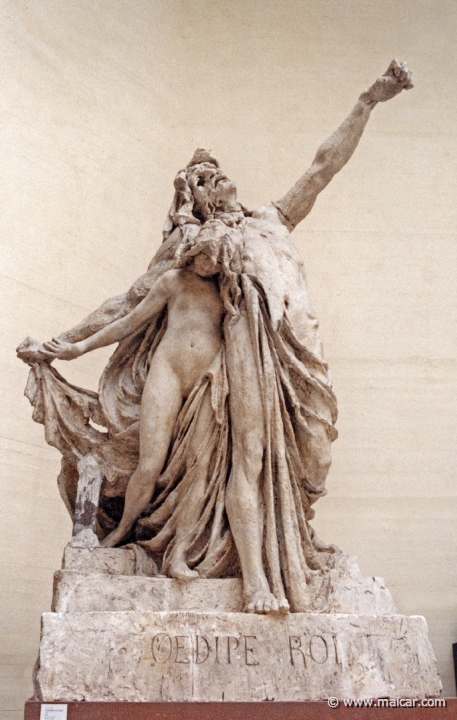
Oedipus

On the surface, connecting Oedipus to my big question is a stretch, Oedipus does not go on any adventure during the course of the play, much less return from one. In fact, the whole story is set on the palace steps. But the great thing about literature and life is that things do not always have to be taken literally; connections can be contrived between almost any two experiences.
So yes, the whole play takes place in front of the palace, but that does not mean there is no journey. Oedipus journeys to find the murderer of Laos, and untimely to find himself. It's a quest for knowledge, and Oedipus "will not rest, the truth must be made known"(line 1011). Like most adventures a change happens, he discovers his identity, his true parents, his fate fulfilled. Through the journey to find truth, Oedipus separates himself from the life he lead before. Instead of trying to return to the life he held (which would be futile, seeing as his wife/mother is dead, and the information he learned is not just something you can ignore), he owns the shift in his identity, blinding himself and leaving the kingdom. Oedipus never returns, never reconciles his new identity with the life he lead before. He makes the choice to move on, keep changing. The moment Oedipus accepts his fate, is also the moment he decides to run away from the life he previously held. I can understand that a return is rendered impossible because of the pain and because Jocasta's decision to take her life. But I think this lack of reconciliation at the end is why I do not find catharsis in Oedipus. Leaving on a new adventure is always easier than coping with returning from one, dealing with fitting back into something after a change. I'm afraid I have always had the inclination to run away from missing things, throwing myself into life and trying not to look back, always focused on the future, disconnecting myself from my past. Always tried to look at each end only as a new life to jump into, regardless of the connections severed with the leap. I think I am critical of this trait in Oedipus because I'm critical of this trait in myself, as constantly running from the past in the pursuit of the future sounds like a cruel way to live.

Sometimes you have to return, and Oedipus does not acknowledge that truth.

http://www.maicar.com/GML/Oedipus.html

Monday, August 29, 2011

"in our wide world there are many goings home"

Three months ago I returned "home". I came back with my rubbermaid trunks eleven sweaters, three tee shirts, four books, and two binders fuller. I came back two and a half inches taller, a few pounds heavier, with hair lighter and longer, skin tan and winter worn. I returned changed, in these, and in many more, less quantifiable ways, to the life that belonged to me for nearly seventeen years after only four months away.
The last three months have been a constant struggle to answer others' questions regarding defining my semester and how I grew and changed, and a struggle to answer my own of how I am changing now, after the adventure.

In ways I still cannot quite pin-point, I changed between January and June. I knew HMI** would change my perspective/attitude towards life and shape me in big and small ways.
BUT what I didn't really consider was that I would be forced to change yet again as I learn to reconcile who I was before I left, who I was when I was gone, and who I want myself to be during my final year of high school.

Some days, as I immerse myself in the Arapahoe community and my life here, it seems like the best option would be to forget, to move on and pretend like my semester at HMI was just the long, long dream it seems to be fading into. There will be other experiences, other chances to shake up my life, other people to love. After all in words of Semisonic "every new beginning comes from some other beginning's end".
But at other times, when all I can do is think of how much I miss the community of RMS XXVI, my heart yearns and fights to return and maintain those relationships as they were. In those times, I cannot understand how anyone can be expected to say goodbye and move on from a community as strong and an experience so full as last semester.
However, I know that both of these options are impossible. I must change again, combine who I was before and who I was during into who I am to be. I must ask myself the big question rolling around in my head:

How do people change after an adventure and are forced to return "home" or to the life they previously held? How do they cope with this transformation?

In
The Poisonwood Bible, the characters go on a grand and life changing adventure as a missionary family in the Congo. Kingsolver spends the first two thirds of the book describing their experiences in the Congo, shaping how the Price Family changes over the two years in the jungle. But the remaining 160 pages are spend on the subject of "going home", or deciding not to in some of the character's cases.

Orleanna and Adah return to Mississippi, but not to the lives they had held before. The noticeable difference is the lack of Nathan in their lives, the new found independence from the controlling man he was. They returned to the same old Bethlehem as very different people. Orleanna stayed distant from her old life by moving to cabin on the outskirts of town. Orleanna seems to be at ease with who she is back "home" in Bethlehem, Mississipi. Adah escaped having to return by attending Emory and becoming a doctor in Atlanta. Adah learned to walk without a crooked gait, and her voice is different in the final chapters, as Kingsolver noticeably drops the use of palindromes in Adah's narration. However, Adah is not entirely contented with how she has changed since coming home : "I miss those poems. Sometimes at night, in secret, I still limp purposefully around my apartment, Life Mr. Hyde, truing to recover my old self"(pg. 492). She relates who she was in the Congo to who she is now, and clearly is uncomfortably with the fact she shed her "old skin" with leaving Africa.

Nathan, Rachel, Leah and Ruth May never return to their old lives. Ruth May obviously couldn't seeing as she died, Nathan refused to leave his missionary work, however failed. Rachel doesn't move back into her old life, instead moving into the role of wife, then business owner, a series of events that seem to be brought and lived with apathy on Rachel's part, not by deliberate choices.
Leah, on the other hand, never stopped moving, never stopped trying to find a place that feels like home. She did not return to Mississippi, because there she was her father's daughter, and in the Congo that all changed. Leah stayed because of Anatole, maybe, but also because she could not bear to let go of the transformative experience of the first two years in the Congo. She refused to let go of any part of who she became while in Africa, even the times she visited Orleanna and Adah, she could not stay.

So, I guess in the Poisonwood Bible we have two people that go home as dramatically different people, one that finds a life to be at peace with, one that made the choice to move on, but misses who she was. Two that never returned home, but not because of any particular choice to stay. And two that found themselves bound to their adventure, to Africa, both choosing to stay with the intent to save.

None of the character's the the Poisonwood Bible were forced to return back to the same life they held before going to the Congo, and that makes me wonder, am I really forced to return to the exact life I held before, or has it transformed as I make small choices contributing to who I am as I again make this place my home?


**for all reading this blog that have no idea what I am talking about when I say my semester away or HMI or RMS XXVI, here's the website of the semester program I did Spring 2011: http://www.hminet.org/HMIsemester

Title comes from "after the adventure" by Morgan Hite